Archive for 2007

Kazakhstan to Hedge Funds: “Mugabe, Set, Match, dudes”

Mugabe is only growing stronger in the world, his discorporated Zimbabwenomic-self is popping up on the very edge of dynamic economic policies. Kazakhstan has announced it will buy publicly listed Kazakh bank stocks until prices return to their normal price (in this case, “normal” should be read as “all time peak”):

Kazakhstan will respond to an “attack” by hedge funds by buying shares next week in the country’s banks that are listed on foreign exchanges to support prices, its prime minister said,

“Kazakhstan is under attack from hedge funds and we will fight back,” Karim Masimov said, after president Nursultan Nazarbayev complained the country was suffering from “unfounded” downgrades of its credit ratings.

The government said it would buy stock of banks until prices reach “pre-August levels” and will do the same for non-banking stocks “if warranted”. The state was also prepared to lend $4bn (£2bn) to banks to ensure liquidity, he said.

Kazakh banks have been hit by the ripples from the US sub-prime crisis. Kazkommertsbannk, Alliance and Halyk Savings Bank are all listed in London. Many banks in the country have also been hurt by an outflow of deposits and waning confidence in the national currency, the tenge. In August, banks suffered “massive withdrawals”.

Recommendation: The Borat mania caused us to be short everything Kazakh, but since then K-Stan has been flying totally under the radar. The implications of a Mugabe-style explicit government put on Kazakh stocks, leads to our valuation models predicting a price for any Kazakh bank stock of X+1, where X is the current market price. We rate Kazakh bank stocks as a “Strong Buy Indeed” because prices, per our valuation model, can only go higher.


Billions and Billions (of Idiots)

NASDAQ stocks, especially those with high betas, fell last Thursday because of a JPMorgan equity research note expressing caution about Baidu’s (NASDAQ: BIDU)3Q revenue estimates. Baidu, which had been trading up several percent at an all-time high of $359, quickly dropped 10%, later closing at $309. That would seem reasonable except:

  • Baidu took the rest of the market with it. Companies like Google, Apple, Research in Motion, and Amazon.com all went from being positive on the day to deeply negative before rebounding slightly. Keep in mind that Baidu accounts for $~66mm of quarterly revenue (i.e., nothing) and yet it is moving hundreds of billions of market cap a continent away!
  • The same JPMorgan analyst who reduced his Baidu estimates today had upgraded Baidu two weeks ago and initiated with a $400 price target. In a report titled Billions and Billions, he had recommended buying a stock with a 34x 2010E EPS multiple

Finance is Even More a Scam Than We Previously Admitted

Several weeks ago, we came out and admitted that finance is a scam. It sounded like we were coming clean, but we admit, we held back a little that we didn’t share. In fact, finance is way more a scam than we admitted.

Citigroup (NYSE: C) (among other banks including BofA (NYSE: BAC) and JP Morgan (NYSE: JPM)) is creating a “super conduit”, essentially a $100 billion backstop for structured investment vehicles (SIV) to add a bid into a bidless market, a market which is 25% comprised of Citigroup SIVs. When the short term loans issued by SIVs to fund their purchase of riskier loan assets comes due, this super conduit will buy the short term paper if the existing holder decides not to roll their existing exposure. The solution to the SIV problem is….a bigger SIV…errr we mean a “conduit” to make sure things are “orderly-like, see”! Citigroup, with the coordination of the US Treasury, will be bailing itself out from having to put these assets onto their balance sheets….and charging a fee for the privilege!

We amend our previous admission to reflect the following: “Finance is really a scam where banks and large international financial firms, all of which are incrementally better and more prestigious than your firm, get together with the collusive glue of the central government, and indemnify themselves from ever having to bring a mistake onto their balance sheets, much less be held accountable for a mistake in any meaningful way.”


Quotes Entirely Relevant to Investing 10-14-2007

Carelessness. I lost my one true love. I started drinking. The first thing I know, I’m in a card game. Then I’m in a crap game. I wake up in a pool hall. Then this big Mexican lady drags me off the table, takes me to Philadelphia. She leaves me alone in her house, and it burns down. I wind up in Phoenix. I get a job as a Chinaman. I start working in a dime store, and move in with a 13-year-old girl. Then this big Mexican lady from Philadelphia comes in and burns the house down. I go down to Dallas. I get a job as a “before” in a Charles Atlas “before and after” ad. I move in with a delivery boy who can cook fantastic chili and hot dogs. Then this 13-year-old girl from Phoenix comes and burns the house down. The delivery boy — he ain’t so mild: He gives her the knife, and the next thing I know I’m in Omaha. It’s so cold there, by this time I’m robbing my own bicycles and frying my own fish. I stumble onto some luck and get a job as a carburetor out at the hot-rod races every Thursday night. I move in with a high school teacher who also does a little plumbing on the side, who ain’t much to look at, but who’s built a special kind of refrigerator that can turn newspaper into lettuce. Everything’s going good until that delivery boy shows up and tries to knife me. Needless to say, he burned the house down, and I hit the road. The first guy that picked me up asked me if I wanted to be a star. What could I say?
Bob Dylan on how he chose his career

Past Quotes Entirely Relevant to Investing


WSJ Follow Up to Finance is a Scam

Today, the WSJ has an article on the recent syndications in the leveraged loan market of formerly hung deals that outlines in detail the “Finace is a Scam” piece from JD last week.

Yet for all the relief among bankers, the sales haven’t come easily — or profitably. They have offered only the highest-quality portions of the debt for sale, and that at a loss. They have also made concessions that could come back to hurt them, such as selling the debt at a discount while the huge supply raises questions about how long both Wall Street’s united front and the upbeat mood will last.

So far, what has been sold is a drop in the bucket. Standard & Poor’s Leveraged Commentary & Data estimates that about $30 billion of a total of $310 billion in North American LBO loans have been sold so far. As much as $100 billion in debt is due to come to the market in the next 30 days alone.

A week before the W Hotel presentation, banks successfully orchestrated the sale of the first big chunk of the $24 billion debt for the First Data buyout. They surprised even themselves by selling almost double the amount planned. The bad news: to accomplish that they agreed to sell the debt at 96 cents per dollar, locking in losses after their fees were figured into the deal.

In some cases, private-equity firms whose deals the debt is financing were among the bigger buyers of the debt. KKR, for example, expressed interest in purchasing a large amount of First Data debt, eventually receiving a $400 million allocation, according to people familiar with the deal.

Recommendation: A portion, if not all, of that $400mm First Data ticket from KKR was financed by Citi. $400mm is an extremely large amount of loans to buy in one deal. Citi and other banks probably provided similar financing to other hedge funds and private equity players; essentially on a net basis, not really selling these loan assets but paying a fee (on top of the discount 96 price or whatever) to get these loans off their books and getting publications to report that these deals have cleared the market with the hope that the banks can then move the rest of the overhang, which is an actual order of magnitude larger than what the banks have moved since the credit crunch began. But don’t worry, credit markets are fine!


Could McCain Be Our Mugabe On Interest Rates?

In a post a few months ago, we outlined the power of Zimbabwenomics, as outlined by economic genius Robert Mugabe in his Mugabe Efficiency Theory. A gap in his theory noted by none of you, is that he does not explicitly address interest rates. Luckily, John McCain, has been working to plug this gap. Per Matthew Yglesias writing on last night’s Republican Presidential Debate:

John McCain on monetary policy: “I’m glad whenever they cut interest rates, I wish interest rates were zero.”

Recommendation: This stance dovetails well with Mugabe Efficiency Theory and extends the “if you make things more affordable, people will buy more” rationale to interest rates. If interest rates are zero, assets will only continue to increase in value because they are more affordable and thus there will be more demand for them, making them worth more. This much is obvious and there is no downside to a zero interest rate policy. But why stop at zero? Negative interest rates would make things even MORE affordable. We look to negative interest rates as the next frontier of Zimbabwenomics.


Finance is a Scam, We Admit It

If you’ve gone into finance from any liberal arts college, you almost certainly have encountered and befriended in the past people who act like finance types are scammy. “They don’t really make anything.” “They just move numbers around and somehow get paid for it.” “They have to be leeches.”

Normally our response was something like “At age 32, I will be worth my weight in gold, literally” or the more cogent, “Finance is a coordinator of economic activity, a grand sorter of what endeavours are the best for the world.”

But with this admission by Citigroup (NYSE: C) that it is loaning money to KKR to buy hung loans off Citi’s books, we will admit it: finance is a scam. A big scam in which people who are incrementally better than you in every way, smugly take money from the plebes, launder it through assorted transactions, and then redistribute to themselves in the form of huge bonuses, bonuses incommensurate to the zero value which they add to society.


Should the US Switch from the Dollar to Monopoly Money?

From user Ignatius:

Even as economists have derided the U.S. dollar as heading toward parity with Monopoly money, Monopoly money itself has held its value with marked consistency.

Price of Boardwalk in 1950: m$400
Price of Boardwalk in 2007: m$400
Concurrent decline in the purchasing power of the U.S. dollar: 87%

Recommendation: Not only would the switch to monopoly provide the US with a more stable currency, but it would also grant the Fed even further control over the economy by enabling them to set the “house rules.” By determining the “Free Parking Rules” and financial outcomes from such events as “rolling snake eyes” and “landing directly on Go”, the Fed could steer the economy with even greater precision. Too little liquidity? Just tell the “banker” to actually become a bank and provide loans rather than solely acting as a cash register. More research is needed, but there seem to be real and compelling reasons for the US to switch to the Monopoly currency.


Quotes Entirely Relevant to Investing 09-30-2007

Everything’s out the window. Tomorrow’s one game. Everything in the last two weeks is in the past and now we’ve got to focus on beating the Padres for a chance to go to the playoffs.
Matt Holliday of the Colorado Rockies, on tomorrow’s one game playoff against the Padres

Past Quotes Entirely Relevant to Investing


How to Get Rich In Dollars

Dear Wisdom of Crowds,

I need help writing my new book, “How to Get Rich in Dollars,” and I am trying to think of alternative titles so I could daisy chain them together with “or” to make my book seem more coolest. Current ideas include:

  • How to Get Poor in Euros
  • All Your US Asset Is Belong To Me
  • Permacycle
  • 4,763 Ways to Skin an Asset Bubble
  • Love in the Time of Non-Existent Reported Inflation
  • Pootie Tang II

This is an imaginary book on real issues, so I expect an especially helpful amount of help from those who can help.

Thanks in advance.

Yours truly,
Johnny Debacle


Does Pfizer Have a Hit on Its Hands? Yes

Pfizer’s (NYSE: PFE) new anti-smoking pill, Chantix, has experienced the fastest sales ramp of any Pfizer drug. Chantix doesn’t contain nicotine; instead, it targets the brain receptors that make smokers crave nicotine. But there are some concerns that the drug causes sleep disruption and abnormal dreams. Here is one example:

The second night, I dreamed I was dating a dinosaur, about eight feet tall and very cute, as dinosaurs go. He lived in a little grotto in the woods near my father (Dad actually lives in a city), and the dream included odd details such as us planning a trip to the seaside and me trying to decide whether to pack a bikini or one-piece.

And here is another:

I dreamed I and two other women were being held hostage by Wild Bill Hickock and his gunslinger pals in a room above a saloon in the Old West. I concocted an escape plot that involved me slitting the throat of one of his henchmen, hiding the body, packing up our stuff and trying to sneak out.
Unfortunately, I also suggested we all go to the bathroom first — as if there were “bathrooms” back in the 1870s — and we got caught by Wild Bill himself, who came back unexpectedly early from a night of gambling.

Further due diligence reveals that these dreams are not “abnormal,” they are actually pretty sweet hallucinations that would normally require at least a hit or two of acid.

Recommendation: LoS proprietary research indicates that the market overlap of smokers and those desiring dinosaur-makeout dreams is quite high. Long Pfizer, assuming they create a separate marketing campaign to target this segment.


Long Russian Mayonnaise; Short Japanese Mayo

Mayonnaise. That’s what’s on every one’s minds these days, the schmegmatic fatty spread du jour. We have gotten hundreds of letters from readers (but surprisingly no e-mails) asking how to play mayo, in a world of volatile changes in prices for such commodities as corn, oil and even molybdenum. Rest assured, we do not disagree with you that it is a good question to ask.

The industry as a whole is difficult to forecast, but an investor can take advantage of specific trends vis a vis one another, vice versa, etc. The two we would focus on would be Russian Mayo vs Japanese Mayo.

Russians consume 7lbs of mayo per year; Japanese only 3.5lbs. While this may indicate that there it’s more likely for Japanese mayo demand to increase relative to Russian mayo several data-points point otherwise.

  • Japanese are smaller than Russian by approximately 7% units of measure.
  • Japanese have a much lower incidence of alcoholism and a significantly lower consumption of alcohol; mayo, like all fatty disgusting foods, is a complementary good to alcohol (per the Taco Bell corollary). With what is going on, Russian booze consumption is likely to diverge even further from Japanese levels.
  • Japanese levels of mayo consumption peaked in 2001, north of 4lbs per capita, declining nearly 15% in only 6 years. This trend is likely to continue as nothing in Japan is well liked for more than 6 years, except for tentacle rape anime, Louis Vitton and xenophobic racism.
  • Mayo margarita’s seem to be a classic indication that they are at best, at the tail end of the mayo mania stage.

While Japanese mayo is tastier, the Russian mayo machine is built for industrial production and its advertising geared around mass consumption. To wit, an Exile.ru piece on Russian love for mayo had this to say:

It shows a fresh salad of beautiful, bright tomatoes, cucumbers and herbs, all glistening after a rinse, and then: the mayonnaise comes cascading down in sensual slow motion. And we’re not talking a dollop of mayo here, folks. Aesthetically, the ad borrowed from a typical American breakfast cereal commercial, only instead of milk splashing down onto Honey Smacks, about a gallon of mayo gets squeezed onto the doomed veggies. And that’s when the announcer proudly tells us how Moscow is famous for its mayonnaise.

We went in search of the answer to why everything from nachos and pizza to borsch and pelmeni (often acting as a substitute for smetana) comes with the emulsified treat. You may have noticed at your local Perekrostik supermarket that most mayo here doesn’t come in re-sealable containers. That’s not an oversight or the result of Soviet central planning – it’s because mayo, like vodka, isn’t meant to be put away after opening. They sell it in 250g plastic bags, which just so happens to be the recommended dose of mayo for most Russian salads on popular cooking websites like gotovim.ru.

Recommendation: Long Russian mayo, short Japanese mayo. Also due to our age, we cannot 100% rule out that mayonnaise is actually the basis for the movie The Stuff, and as such, poses the possibility that it is an “insidious white glop that [was] discovered by miners[,] has a highly addictive taste [, is] sold to general public in pint containers like ice cream [and] is actually alive and gradually takes over the brain, mutating those who eat it into bizarre zombie-like creatures.” Consider yourself warned.


Quotes Entirely Relevant to Investing 09-23-07

The true measure of a career is to be able to be content, even proud, that you succeeded through your own endeavors without leaving a trail of casualties in your wake.
Alan Greenspan

Past Quotes Entirely Relevant to Investing


The Llama of Lame

To: The Fed
From:
Long or Short Capital
Re:
You suck

Dear the Fed,

You suck. You don’t have a backbone and as a result you are slowly and very surely making our country and our currency irrelevant. Usually the masses rebel and bring down great empires but luckily for us democracy fixed that problem. Unfortunately, democracy can’t fix how lame and fickle you are and so you will be our ruin.

A few things to tell you:

1) Inflation isn’t 2% like your pathetic CPI ex-Food & Energy says it is.

First of all, as far as I can tell food and energy are the only two items you should NEVER exclude from an inflation index. Tell your wife and kids they can have everything in the consumer basket except food and energy and you will quickly see that they are actually the two MOST important and indispensable factors in the CPI. You can find substitutes for, or go without, everything in the basket EXCEPT those two.

Secondly, stop using “Seasonally Adjusted Intervention Analysis” it’s as sketchy as the Seldom-Accepted-Accounting-Principles (SAAP) we use to cook the books here at LoS. I mean writing a computer program to automatically remove any items in the basket which deviate meaningfully from the previous year? Isn’t the point of the data to SHOW the change versus the previous year not hide it? Oh, I found the list of items that you’ve adjusted for and it’s embarrassing.

The majority of adjustments remove price increases with much less frequent adjustments for price declines. You’ve basically left dairy products out of the index for the last 5 years citing outrageous one-offs like “a generally tight cheese market” as justification for this. And as if reporting a separate ex-energy index wasn’t enough you’ve statistically intervened to remove the effect of higher energy prices even in the index that’s supposed to INCLUDE energy. In one outrageous case you removed the effect of fuel oil for three months in March 03 and the reason you cited for the “abnormal” move was the “end of winter,” yeah I was surprised as sh-t when winter ended in Spring 03, it was wild! For a real measure go back to the old method, you’ll see inflation is at least double what you’re reporting.

2) Grow a spine you slimy invertebrate

The market has a memory. Over the past 15 years you trained us to believe that no matter how much risk we take, and how much we lever that risk, if anything really scary comes down the pike then you will bail us out. Now we all run around like reckless, spoiled 16 year olds bidding up the price of anything we can get our hands on and not worrying about consequences because daddy (Greenspan) and mommy (Bernanke – that’s right you’re spineless AND a girl) will get us out of any trouble we get in. Well you’re only making the problem worse and we aren’t learning anything so we’ll continue taking stupid leveraged bets creating bubble after bubble so you can tip-toe around trying not to pop any of them.

3) You’re lying to yourself if you think we still have real GDP growth in this country.

I challenge you to find one measure of wealth OTHER THAN THE DOLLAR which shows the US economy as worth more now than in 2001. If I wanted to buy our country it would cost me 30% fewer euros today than it did in 2001, it would cost me less bars of gold, less barrels of oil, less ounces of copper, less btu’s of natural gas, less cubic feet of lumber, less of almost anything that has intrinsic value. Yet you keep reporting GDP growth, why? Because your quick fix is to effectively print more money so that in dollar units everything is getting more “valuable”. But guess what, to the 95% of the world that doesn’t use dollars the true value of the US economy has been shrinking, rapidly.

It’s like a company doing a 5 for 4 reverse stock split every year and claiming to have 20% eps growth, you haven’t changed the earnings just the units those earnings are measured in. The rest of the world is telling you our country is worth less by massively selling our currency and you still naively think we’re growing value – I feel like I’m at a gathering of the flat earth society or in Zimbabwenomics 101.

This will come back to bite you but not nearly as much as it bites us. The cheaper the dollar gets the more expensive all our imports get, inflation will rise faster than you can statistically manipulate it and when that happens expected inflation goes through the roof (which as you yourself have pointed out many times is by far the most serious threat to economic existence). Then the only way out will be interest rate increases as swift and severe as all the cuts have been. All the bubbles will pop at once and then we’re really in for it. Maybe it’s 10 years away but there’s a toll collector at the end of every free ride.

When will you learn that recession is ok? It’s actually healthy, it’s the cycle, it’s how things have worked for a thousand years. Trying to prevent every small recession is going to end in one huge recession (ie. depression) and no one will trust you anymore which is a much bigger problem. No economy in history has ever been able to successfully inflate its way to health, this won’t be any different.

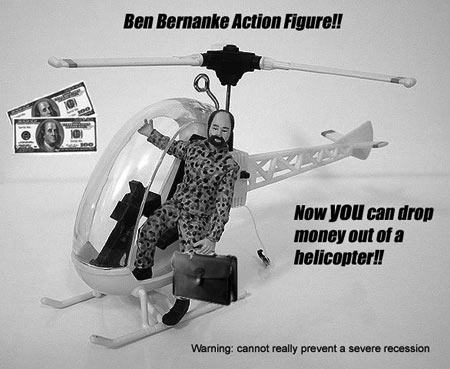
Benny, I know you had to trade in your hypothalamus and spine to be fed chairman and now you biologically over-react to everything and are incapable of standing up straight when confronted by bully-morons like Kramer. But I’m hoping you at least still have your brain. Before you had this job all your published research showed that central banks should strictly target inflation and should be ignorant of asset prices. You had good reasons for this conclusion, don’t forget them.

Subprimely,

Long or Short Capital Management

« Previous PageNext Page »