Author Archive

GOOG, No Means Yes Baby Part 1

Analysts are apparently panting down the trail for some “hot Google action.” Our attention was piqued by reactions of leading sell-side analysts to Google (GOOG) CFO, George Reyes, at a recent Merrill Lynch investor conference.

Reyes initially commented that, Google is “getting to a point where the law of large numbers starts to take root…” He continued to say that “At the end of the day, growth will slow…” and that “We’re going to have to find other ways to monetize the business.”

The sell side responded with comments including:

“We don’t believe there is any new or faster slowdown in Google’s growth than what we have already modeled.”
-Safa Rashtchy at Piper Jaffray, who has an “outperform” on Google

“Our thesis, growth expectations, and implied value of $500 are unchanged.”
-Goldman Sachs’ Anthony Noto, who has an “outperform” rating on Google

“We believe comments made at a competitor’s conference this morning, by George Reyes, were likely not intended to reset investors’ expectations about growth prospects.”
-Oppenheimer’s Sasa Zorovic, who rates Google a “buy”

“I’d hit it.”
-Unnamed Analyst

Goldman Sachs’ Prescott R. Moncrief III upgraded Google to “Technically Legal” from “Legal.”

The general analyst sentiment abounds with Corporate Date Rape Logic:

GOOG, I know you want to take it slow, but I’ve had three shots of jagermeister, you look hot and I’m thinking that you and I have at least a couple more quarters of stellar growth. I’m talking 50-60% per quarter and a price target of $1400. I’ll tell you what — have a couple more sips of your Smirnoff Ice and we’ll try just the earnings tip — if it doesn’t feel right we’ll take your price target right back down.

Google responded to the above analysts with the following clarification in a written statement:

“…moreover, as we have stated in our SEC filings, our revenue growth rate has generally declined over time and we expect that it will continue to do so as a result of the difficulty of maintaining growth rates on a percentage basis as our revenues increase to higher levels.”

One Goldman Sachs analyst, who answered Pres’ phone insisted “He’s busy with Yahoo at the moment. Wait this isn’t his wife, is it?” but then replied:

“Off the record, it’s clear that Google’s revenue growth rate has not declined over time and I don’t think she will have any difficulty maintaining growth rates on a percentage basis even as their revenues increase. My target price of $950 stands.”

Stay Tuned: We interview Prescott R. Moncrief III in Part 3.
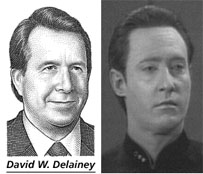

Short David Delainey

Former Head of Enron Energy Services, David Delainey has problems stemming from his admission to acts of perjury including lying to the FBI. But those are peanuts compared to the trouble he is in for spending years posing as Star Trek’s “Commander Data,” and pocketing thousands of dollars in appearance fees at various “Star Trek” conferences and events.

dd2.jpg
A History of Deception?

Recommendation: Short David Delainey. Market Underweight Star Trek conferences. Accumulate the Wookie.


Long on those who go Long on Shareholder Lawsuit Lawsuits

According to the 10b-5 Daily, according to the Economist, according an article in the Stanford Law Review, according to a study by James Cox, according to data collected from 118 securities class-action suits between 1995 and 2002, 72% of institutions never claim their full share of the lawsuit proceeds.

The always interesting 10b-5 Daily notes that the article notes that institutional investors may be “violating their fiduciary responsibilities when they do not try to get their money” from firms violating their fiduciary responsibilities and could be the subject of “class-action suits” over the improper handling of class-action suits.

Told two friends, and she told two friends and she....

Recommendation: Start going long on anything going long on shareholder suits that sue firms that fail to file shareholder suits.

We are also shorting shorters of Funds of Funds invested in Mutual Funds, the frequent victims of the victims of shareholder lawsuit lawsuits.


Short Expectations

The following was contributed last week by our new writer, Equity Private, who has an excellent blog about being an private equity insider. Both He/She/It (“Hsit”), along with Female to Be Named Later (links to her blog), will be contributing at will.

Meta data surrounding “investor relations” has the potential to become a derivative vehicle itself. Investor Relations (“IR”) is a field which has developed into an art and a science due to the importance of earnings announcements and the triumph of the short-term (12 week) focused analyst over the long-term (12.5 week) focused analyst. Below, we outline a system to guide equity strategies in this realm.

Expectation Expectations (Expectation Derivatives)

Relations strategies employed by firms can best be understood on the two axis defined by the continuum between “passive” and “active” on one axis and “earnest” and “obscene f***king fabrication” (“OFF”) on the other.

  • Firms with little communications program are on the “passive” side of the continuum. The likelihood that a given firm will fall to the passive side of the continuum is inversely proportional to the square of the total theoretical mass of the egos of the senior management. (The number for our analysis is 2 and consists of GOOG and the NYSE-listed firm whose IR department spent their entire annual budget at strip clubs prior to the collection of data).
  • Firms with frequent, detailed, descriptive and lengthily communications are on the “active” side of the continuum.

  • Firms with honest, direct and accurate communications are classified on the “earnest” side of the continuum. The number of firms on this side of the continuum is also quite small. (Note: If the definition of “honest, direct and accurate” is refined to omit profanity directed at analysts on investor calls this number drops to zero).

  • Firms with inaccurate, misleading (intentionally or otherwise), obscure, evasive, or immaterial communications are classified on the “obscene f***ing fabrication” side of the continuum. 950 examples of these firms exist among the Fortune 500. (Note: This figure includes 450 off balance sheet “special purpose entities”).

  • Firms with highly active disclosure profiles and highly OFF-leaning disclosure profiles quickly burn reputation capital among analysts and observers. The short term gains initially realized by such firms are quickly lost following discovery of the firm’s true location near the far frontier of OFF. Firms in the first OFF quartile show net losses of -56% compared to other market actors. These losses, however, typically follow a huge wave of gains.

  • Firms with active and “moderately” OFF disclosure profiles perform poorly as well. Throughout their history their only moderate OFF position communicates results below those of the high OFF actors. Since they appear to perform poorly relative to the high OFF participants they are discounted by investors.

  • Firms with passive leaning disclosure profiles also perform poorly. Those with OFF leanings suffer versus active OFF leaners as they are perceived to release “too little good news,” according to one CSFB official who commented on condition of anonymity from federal prison. Those with earnest leanings are characterized as “boring, with too little good news.”
fallingart.jpg

Efficient Frontier Dangers

Even firms along the efficient frontier of OFF/Active boundaries face perils. Dell(DELL) is classified as an active OFFer. Dell’s carefully crafted investor relations program has had the effect of depressing earnings expectations consistently for years. Unfortunately for Dell, analysts have grown sophisticated; they publish one set of expectations while harboring another set of “double secret expectations” amongst themselves. These “double secret expectations” are generally arrived at among analysts at a quarterly secret meeting in the “champagne room” of Scores.

Dell’s failure to exceed the second tier of secret expectations is punished. In response, Dell began to offer even more depressed earnings guidance based on second derivative expectations (their expectations of the analysts expectations). There are rumors that Sell Side analysts are now developing in the lab a third derivative expectations but shortages of key ingredients such as molybdenum and bullshit have hampered their efforts.

Recommendation:

For investors with longer horizons:
Short firms with investor relations programs

For investors with shorter horizons:
Go Long on newly listed firms with budding investor relations programs and sell immediately after the third quarter of disclosures.

But we expect that you expect that we already expected that you expect this.


« Previous Page