
July 6, 2008
Quotes Entirely Relevant to Investing 07-06-2008
Freedom is the last, best hope on earth.
-Abraham Lincoln
Freedom is the last, best hope on earth.
-Abraham Lincoln
No man loves America more than Neil Diamond and no man wants your 4th to be better and freer than Neil does.

Except the staff of Long or Short Capital.
In its recent presentation to investors, Yahoo correctly pointed out that Carl Icahn has not had much success in recent battles with corporate management. In fact, his track record looks miserable. But they made a key error in their analysis. Where is Yahoo on this list? As one of his largest and most public failures, shouldn’t Yahoo be included in the list of his underwater investments?
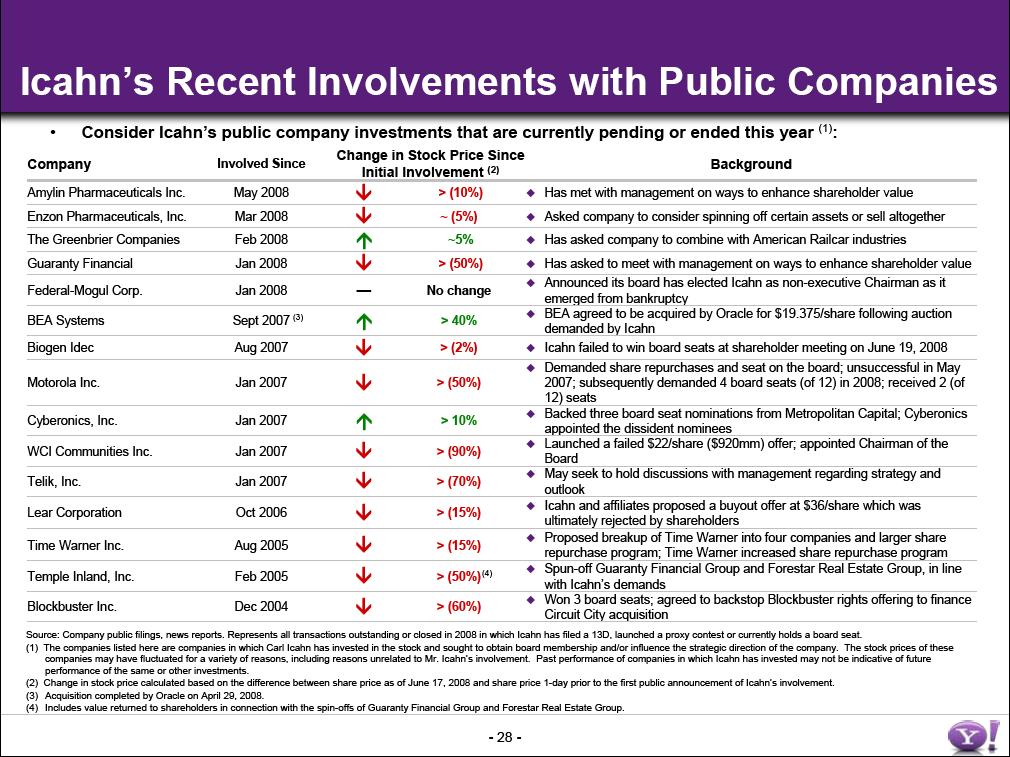
Dear Yahoo!,
About a month and a half ago, we provided you with a free report on how to increase your value. Since then, you have not followed any of our suggestions. In particular, our suggestion #8 — “Let the company be bought by Microsoft (NASDAQ: MSFT) at a 50% premium to YHOO’s closing price before MSFT’s February bid” — went unheeded.
Since then, you have chosen to take a few other actions including:
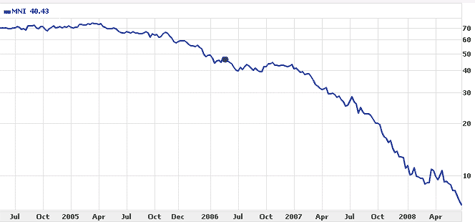
However, I must give credit where credit is due. Congratulations on:
Had we known here at LoS that this type of success was possible, we would never have issued our initial recommendations. Our apologies for failing to see the bigger picture.
Sincerely,
LoS
I don’t consider myself a home-run hitter. But when I’m seeing the ball and hitting it hard, it will go out of the park.
-Ken Griffey Jr.
In light of the fact that Carl Icahn has recently begun blogging, we thought we should point our reader in the direction of the time Carl tried to take us private and started his own blog (formerly located at liquidiconcapital.com).
Recommendation: Historical perfomance may not guarantee future performance (or so some claim), but fake reality can be a useful guide to future reality.
What each man does will shape his trial and fortune.
For Jupiter is king to all alike;
the fates will find their way.
-The Aeneid
 Sometimes it seems that population experts must spend their entire lives discussing birth rates. “Country X has so many people it is falling apart and they need to all be sterilized. Country Y has so few children that everyone needs to be forced to procreate. This country blah blah blah.”
Now I see that the experts are concerned that “Japan [is] Steadily Becoming a Land Of Few Children.” The theory is that just because the Japanese have basically substituted Pokemon toys for children in their culture and shun immigrants as a culture, they will eventually run into problems when they’re all old farts and don’t have any young ones to care for them.
Isn’t this really a case of cutting the wheat from the chaff? The Japanese have realized that babies are just not that smart, not that educated, not that good at work and cost a lot to maintain. Society suffers all of that just in the hope that these babies will one day take care of the society, an idea of dubious merit given the qualities of your average baby. Why not do away with the baby overclass altogether? This is what the Japanese are planning.
While the idea sounds attractive on the surface, the potential problems of who takes cares of an elderly society remains. Japan has addressed the care giving shortfall by “subsidizing the development of robots as caregivers for the old”. So smart. No one, not even a stupid baby wants to deal with smelly old people and their problems. Japan has also solved the deep-rooted needs of society to feel like parents by means of digital pets (basically the same thing as a baby) and assorted synthetic maternal love simulators. The Japanese have leapfrogged us once again in the area of efficiency.
Recommendation: Long Japanese society. Short procreation. Long Pokemon and care-giving robots.
Those who know how to win are much more numerous than those who know how to make proper use of their victories.
-Polybius
Scepticism is effortful and costly. It is better to be sceptical about matters of large consequences, and be imperfect, foolish and human in the small and the aesthetic.
-Nassim Taleb (ht: Market Moves)
It’s frequently said that you can’t get something for nothing. This is true. But what is the price of something? Difficult to know. This has been a market that lacked liquidity and price discovery.
Luckily, the Something Store has started making a market in somethings. You can buy as many as you like for $10 per something. I suspect they are capturing a large producer surplus here — somethings may well be worth less than $10 — but I nonetheless admire their willingness to make a market in something.
Recommendation: We’re still working on how to make a market in anything which seems to be a dangerous proposition. Something can be more valuable than anything, but in a discretionary context, anything is likely to be a lot more valuable than something. Nothing can actually be more valuable than anything or something. And then you bring everything into the equation and it’s worth either zero, infinity or negative infinity, and there is clearly a lot of science that needs to be done.
Freedom in capitalist society always remains about the same as it was in ancient Greek republics: Freedom for slave owners.
-Vladimir Lenin
“General Motors Corp., the biggest U.S. automaker, said it still has enough liquidity through 2008.” And then what?
If you say you have enough liquidity through the end of the year, you don’t have enough liquidity.
Recommendation: What’s good for GM (subprime loans, CLOs, etc.), is not good for the country.
You know, the usual: supreme power, undue influence over others, world domination.
-David Harding of Winton Capital Management when asked about what drives him in Traderdaily