Author Archive

Translating Corporate Speak: Wynn [Unforeseen Upside Edition #2]

In February, we pointed out Steve Wynn’s colorful and frank commentary on his company’s quarterly call. Today, we follow up with more from the CEO of Wynn (Nadaq: WYNN).

First, if you recall, Wynn issued $660mm of shares at $154 at the end of September after his stock had doubled in 6 months. Explaining his reasoning, he said at the time:
“No company gets to be worth twice as much in 60 days as it was before to any intelligent person, so when that happens, we take advantage of it.”

Smart. Now, one quarter later Wynn has repurchased 2.4 million shares. As he said on this quarter’s call:

“Look, we issued 4.4 million shares for 660 million and promptly distributed it, which was really nice for us shareholders. And a return of capital. We have now bought back at 50 or $60 a share [cheaper] those shares that we issued.”

Translation: You were idiots to buy my shares at $154. But I appreciate you selling them back to me at $95. Thank you.

Additionally, while most companies talk up their own business and exaggerate the prospects and profitability of the business, Wynn opts for honesty.

We report and talk about these EBITDA numbers with our chest puffed out as far as we can get it as an industry. I suppose it tells you how much money you can afford to pay in interest. But the public needs to understand that the profitability, the real profitability of these businesses are much, much less than these puffy EBITDA numbers. Interest expense is very large. And depreciation, I know office building guys and shopping center guys and apartment guys, they get to spend part of the depreciation. But, believe me, in my 40-year history and in the history of every other gaming company here, Kerkorian would agree with me. We spend depreciation. It is a real expense. And when you take the profitability of a hotel like the Venetian or Wynn or Bellagio or any of us it’s a much smaller number when you subtract depreciation and interest. And amortization. We have to pay back the people who lend us the money eventually. It’s a much smaller number. But I know the Wall Street folks, you all like to talk about EBITDA.

Translation: I don’t understand why you think my capital intensive company should be valued on metrics that exclude any measurement of capital intensity. I would use a different approach than you muppets, but then again, your approach is lining my pocket and I will restrict letting you know this explicitly such that no one will pick up on it except those who can parse my words with some kind of proprietary translation algorithm for corporate speak.
Quotes Entirely Relevant to Investing 05-04-2008

I think that a man should not live beyond the age when he begins to deteriorate, when the flame that lighted the brightest moment of his life has weakened.
-Fidel Castro

Past Quotes Entirely Relevant to Investing


More Frankonomics

Barney Frank is in full regulator, politician-in-need-of-something-to-yell-about mode. Unfortunately, I must note that Mr. Frank is among our most financially-savvy elected officials (gulp) as well as one of the leading advocates of Zimbabwenomics. In this interview with the Economist, he discusses his misguided rationale for dealing with the current financial mess and, as any good politician should, proposes to 1) increase government regulation and 2) increase taxes.

1)

“[Hedge funds and unregulated pools of capital] caused the problem by making a wide ranges of loans that shouldn’t have been made. Now some of the borrowers shouldn’t have borrowed… but there was no regulation to prevent abuse.”

“If only [banks and credit unions] were the originators, there would be no subprime crisis and no recession today.”

Now every major US bank I can think of – Citigroup, BofA, Wells Fargo, etc. — has written down billions in losses from the sub-prime, Alt A, sub-crap, and moderate-crap mortgages they held. Additionally, they are still trying to unload the billions of remaining debt still on their books from their loans to the only group more levered than sub-prime borrowers: private equity firms. These banks were regulated but they still participated, enabled, benefited from, and ultimately suffered as a result of the sub-prime fiasco. Why? Because the problems that the financial system has suffered over the last 18 months are the result of an expansionary credit cycle. Credit begat credit until temporarily insane lenders gave cash to un-worthy borrowers. Sub-prime were the symptom of this craze rather than the cause and while regulation may have been able to stem some of the more egregious abuses, an expansionary credit cycle will find a way to wreck damage.

Here’s Warren Buffet on the subject:

There are significant limits to what regulation can accomplish. As a dramatic illustration, take two of the biggest accounting disasters in the past ten years: Freddie Mac and Fannie Mae. We’re talking billions and billions of dollars of misstatements at both places.

Now, these are two incredibly important institutions. I mean, they accounted for over 40% of the mortgage flow a few years back. Right now I think they’re up to 70%. They’re quasi-governmental in nature. So the government has set up an organization called OFHEO. I’m not sure what all the letters stand for. But if you go to OFHEO’s website, you’ll find that its purpose was to just watch over these two companies. OFHEO had 200 employees. Their job was simply to look at two companies and say, “Are these guys behaving like they’re supposed to?” And of course what happened were two of the greatest accounting misstatements in history while these 200 people had their jobs. It’s incredible. I mean, two for two!

It’s very, very, very hard to regulate people.

LoS prediction: Frank and his legislative cohort will find a way to prevent any of the abuses of this cycle from recurring. Say good-bye to pick-n-pay, Freedom, and pay option loans. However, this regulation will do nothing to prevent the excesses of the next expansionary credit cycle, scheduled to start in 2012 which may include Magic Loans, Money Tree Triple-Reverse Amortizing ARMs (if it works in old-time college football, it can work in loans), Collateralized Magic Loan Obligations, Ultra-SIVs and our favorite, Chocolate Covered Mortgages, which will not not only be affordable but delicious.

2)

“First, try to pay as little as possible [to bail people out].”
“I’m willing to give [homeowners who can’t afford their houses] some help. Not direct taxpayer assistance but some other type…”

“They didn’t bail out Bear Stearns. [The Fed] bailed out the people who did deals with Bear Stearns.”

Now for the classic politician’s sleight of hand. When people won’t tolerate direct transfers of wealth, make the transfers indirect. The First Law of Bailouts is that Someone Must Pay. So when Barney says that he’s willing to give homeowners who speculated on housing (and lost) “some help” but that won’t involve direct taxpayer assistance, he’s not quite lying. Instead of giving these people straight cash, he will find some other ways to transfer taxpayer dollars to these people (voters).
Similarly, it’s true that the Fed didn’t bail out Bear Stearns. After all the company was sold to JP Morgan and the employees lost most of their equity. However, he failed to mention that the Fed DID bail out the Bear Stearn’s bondholders [see John Hussman’s insightful analysis] who did nothing to deserve the preferential treatment.

Recommendation: Stop voting for politicians who cannot think more than 2 steps ahead of themselves. Stop voting for politicians who have never heard of the 2nd (forget about the 3rd) order effects.


Thank You Child

Dear Future Child of Mine [Chase or Madison depending on your gender],

Thank you for the tax rebate. $600 was a very generous gift for such a small child. I know that, at some point in the future, you will have probably have to work a full week — taxes will be higher — to pay for this gift. So I want you to know that I really appreciate it. I have been frivolous lately and made some bad decisions (the 2nd home with the pik-n-pay mortgage, the jacuzzi, the viking kitchen) that I really couldn’t afford. So I’ll probably use the $600 to pay off some of my personal debt. That will leave less debt to eat into the estate I’m planning to leave you (post-tax, of course)!!

Sincerely,
Dad


Long Bonds

In this time of financial uncertainty, we have experienced heretofore unseen volatility in our portfolio. Assets that were previously uncorrelated are now correlated, assets that were previously correlated are now uncorrelated, write-downs are good, the recession either didn’t happen or is already over, LIBOR is possibly a figment of a banker’s imagination and it’s always the best time to buy. As such, management has decided to allocate a significant amount of our cash on the balance sheet into a fixed income product that shows no correlation with any of our current holdings and is not in any way sensitive to interest rates.

Our new favorite fixed income product is barry bonds. We have invested a meaningful amount of our cash into this asset and the maturity is one year. The yield is 0% on a cash basis, but approximately 25% based on our performance enhancing risk model.

We think barry bonds will help dampen the volatility we have seen in our portfolio as the only thing they correlate with is steroids, perjury and racism. In turn, this should allow our subscriberholders to benefit from more stable returns. Yet again, we say, “You’re welcome.” We considered a pair trade with a short of roger clemens so that we could effectively short the racism spread, but that trade looks to continue to be volatile.


Quotes Entirely Relevant to Investing 04-13-2008

Anytime is the best time to buy.
-Kieran Quinn, chairman of the Mortgage Bankers Association

Past Quotes Entirely Relevant to Investing


Barney Frank is The Mass Mugabe

Politicians are generally great at what they do. We know that. It’s a group that self-selects for blowhards and megalomaniacs with a thorough understanding of Zimbabwenomics. And certainly, Massachusetts politicians typify these tendencies. But even by the Mugabian standards of politics, things are getting out of control (in a good way).

[Barney] Frank’s idea is that, for mortgages originated between the start of 2005 and mid-2007, a lender and borrower would be able to agree on a federal refinancing plan. Lenders would have to write down their loan to no more than 85% of the current appraised value of the property – which means the banks will use this opportunity to unload the biggest stinkers in their loan portfolios.

For the borrower, the deal is even sweeter: a low fixed monthly payment and a reduction in the principal to market value. The Federal Housing Administration would then guarantee the loan, up to a total of $300 billion in total Frank Refis. The deal is so sweet that even Mr. Frank is concerned that otherwise reliable borrowers may “purposely default” to be eligible for assistance.

Just to be clear, what Mr. Frank is proposing is to bail out anyone who took risk on a house they couldn’t afford. Many of these people will have, smartly, put little to no money down to take that risk and benefit from the potential upside were the house to appreciate. How is he planning to finance this proposal? Taxes, of course. So those who dumbly did not take risks with large potential upside will now pay those who did. This is an extremely Mugabe efficient proposal and will be a resounding success with no downside.

Recommendation: Long excessive risk-taking, just make sure to do it in a group large enough to form a voting bloc. Also, I have found that Zimbabwenomics is much funnier when it is not happening in my country.


Short Timothy Sykes, Long Reason

I don’t get him, his relevance or why he continues to amuse people. But Tim Sykes certainly exists. I know this because he emailed me.

Hey there, how are you? I’m blogging like a madman and loving every second of it! I’m putting together a huge list of money/finance/trading/investing blogs/websites to be called ‘TIMlinks’ so I wanted you to join. It’s free and once I start promoting this baby, you should get dozens or even hundreds of daily visitors to your site—kinda like FeedTheBull, Entrecard or Blogrush, but for our target audience only Check it out:

http://timothysykes.com/timlinks/index.php

After your join, to get ranked, you’ll be emailed code for a ‘TIMlinks’ badge, just add it anywhere on your site and you’ll be set!
– – – – – – – – – – – – – – – – – – – – – – – – – – – – – – – – – – – – – – – – – –
Timothy Sykes | Author of An American Hedge Fund
T 407.xxx.xxxx| F 407.xxx.xxxx | www.timothysykes.com

It’s telling that his system is identical to every splog and SEO-only oriented link trading request we get. They link you from their non-main page, you link them from your main page. A great deal! We should get hundreds of links a day from a separate links page buried within a mediocre site! Seems probable.

We don’t do reciprocal link trading or such things. If it’s a site we read and if it’s one we think deserves to be linked, we link it. Feel free to do the same but we won’t be adding a badge or trading links.

Regardingly,
Mr. Juggles
longorshortcapital.com

You will agree with me when I say that I tried to be polite.

Haha ok

His repsonse naturally raised the question to me “What was funny in that?” As a master of humor, normally these things make themselves aware to me. In this case, it did not. Naturally my reply was:

What was funny in that?

From Timmy:

u just sounded so serious, i’m just trying to help increase the popularity of the sites i like by giving them this badge of honor

More like a scarlet letter.

A badge of honor, Tim? Really? We take everything we do very seriously, that’s one of the reasons we do it better than anyone else. Maybe you should start practicing your seriousness and take your site to the next level. Again, you are free to link to us and we encourage you to do so — it is likely to your readers benefit. We won’t link to you until you have created a site worth reading, one that we also happen to read.

I expected more laughing and something non-intelligent from his next reply. I was not disappointed.

LOL, being serious and the best is the exact opposite of what I’m going for, all I wanna do is teach and entertain, aka actually help people understand this stuff better! All you finance snobs forget 99% of the people out there have little to no education and thanks to the ridiculous importance you place on always being the best, people believe mistakes are just about the worst thing you can do. Wrong! I like some of your articles, but take it down a notch, you’ll live a happier and more fulfilling life!

My reply:

Teaching and especially entertaining are both things which benefit from being taken seriously. No one learns anything from someone who is taking a half-ass dimwit approach to teaching. Worse, no one is entertained or is made to laugh by people taking a half-ass dimwit approach to humor.

Mistakes are ok, but mistakes that should have been avoided but weren’t because of sloth or lack of diligence are horrible and should be treated as such. They are entirely avoidable by people who take things seriously. Life is a very serious thing. We are all dying. Asset management is even more serious than life.

Regardingly,
Mr. Juggles
longorshortcapital.com

Timmy’s reply:

Solid reply but you forget that the vast majority of people out there are lazy and dim-witted. For them, the very thought of long complex calculations and ramblings from boring finance people is equatable to prison. What do we do, ignore those people and laugh at how much better we are?

No, I believe those people can and should learn about the stock market and since Penny Stocks are pretty simple things to understand, it’s a great intro. And, I can help them avoid the mistakes I’ve made, lessons I was forced to learn alone because there was nobody in the entire snobby/stuck up world of finance who ever detailed their stupidity for all to learn from. Again, stupidity/mistakes–nothing to be ashamed of, we all make stupid mistakes at one time or another, the key is learning from them and sharing them right alongside our greatest victories. Welcome to my business model: brutal honesty. It’s sad that this is revolutionary, but thanks to the kind of people in this industry, there’s a massive window of opportunity. Thanks again!

Played Out

Recommendation: Timmy is a blackhole. A blackhole of knowledge, understanding, financial acumen, reason, emails and time. If you have not yet crossed the event horizon of Timmy, keep back. At best, he is played out. At worst, you will lose brain matter as it is stretched to infinity, taken to the speed of light and crunched into a superdense nothingness.


Quotes Entirely Relevant to Investing 04-06-2008

Blessed are the young, for they shall inherit the national debt.
-Herbert Hoover

Heston Addendum:
Get your stinking paws off me, you damned dirty ape!
-Charlton Heston in Planet of the Apes

Past Quotes Entirely Relevant to Investing


Topping the Bottom

I’m calling the top on the bottom. So many people have been calling the bottom. For instance, today non-farm payrolls were down 80k and unemployment jumped to 5.1% (both are clearly trending negatively) and yet the market is rallying (S&P500 up 11pts, Nasdaq up 26pts). This must mark the bottom!
Other bottom-marking rallies:

  • Bear Stearns bankruptcy rally
  • UBS $19bn writedown rally
  • Fed liquidity injection rally (several)
  • Doug Kass, Bear turning Bull rally
  • Sovereign fund injecting enough capital to achieve solvency rally (several)
  • Commodity bubble bursting rally

That’s a lot of rallies based on various factors that certainly, definitely, surely mark the bottom. Unless they don’t. Which they don’t.

Recommendation: Short the bottom. Go long the top.


Forecasting Bonafides

From a tweet I put out immediately when the jobs report was released this morning:

Rally time! The new paradigm is not bad news = good news, it’s everything bad has already happened, only good stuff ahead!

Recommendation: Nothing on Heaven, Hell nor Earth can or will make the S&P 500 go down. It has been immunized against negativity.


Market’s April Fool’s Joke

Facts admitted to in the last 24 hours:

  • UBS (NYSE: UBS) needs to raise $15 billion in capital
  • UBS wrote down $19 billion
  • UBS chairman is leaving
  • Deutsche Bank (NYSE: DB) admits they are lying bastards by only writing down $4 billion
  • Lehman (NYSE: LEH) is trying to raise $3 to 4 billion in capital

Market reaction pre-opening from the WSJ.com:

Stock futures extended gains as investors opened the books on a new quarter by betting that the latest write-downs from UBS and Deutsche Bank have put most of the worst damage to banks and brokers from the credit crisis out in the open. 9:10 a.m.

Recommendation: Hey everybody, April Fool’s!

Postscript: The Dow Rallied 391 points on the day, no joke


Shareholder Activism Taken To Its Highest Level

Bear Stearns (NYSE: BSC) shareholders have raised the ante to the ceiling in terms of shareholder activism. Previously, an activist was limited to only inflicting pain on management or the board to eke out concessions and improve the company. But BSC holders have the gun right to the head of the entire US financial industry and it went something like this.

Weekend 0: Listen rest of the world, we stock holders may have negative value and the bondholders should lose money, but that’s just your reality, not ours. It’s pretty simple and it goes like this. If you don’t pay us more, we will bring the whole thing down — we will do it so pay us the money. Pay us $2 and we will go away quietly, and the bond holders would be pleased. You have 24 hours or we blow it all up.

Week 1: JP, we’ve been thinking. No, not about that hooker with the dysentery. Yeah. Haha. No, we never heard that variation. That’s a good one. No really it was good JP, the delivery needs some work but you’ll get it there. Just practice in front of a mirror or your mistress. Anyways, yeah, we have thought about it and that $2 per share for our stock is not enough. What about $10? JP, you got that cash lying around, right? Even if you don’t, here’s what you do, ok? Call the Fed, and ask for Bernanke. Get him to give us at least $29bn in capital, not a penny less. Tell them if he doesn’t do it, we will vote down the deal and blow it all up. Illegal schmegal, he’ll do it. Tell him he has 24 hours.

Week 1.5 to Present: Ok we have $10 but now based on how stable things look, we should be getting at least $15. It’s pretty clear that we’re worth a lot, especially now that the Fed has given us $29bn of the taxpayers money. Btw thanks Taxpayers, we were worried for a sec back there that we might lose some money because we invested in a company that took on way too much risk, never deleveraged enough and that got caught in a squeeze. God forbid, that the equity holders, much less the unsecured bond owners be forced to take a zero or a hit in such a situation. Back to the matter at hand. We want $15 per share in the next 24 hours, or we will blow it all up. All it up. All it. Everything. It. Blown up.

Recommendation:

  1. Pick a company that is too big too fail (basically anything publicly traded and kinda banky) that has traded down to sub-small cap levels
  2. Purchase the stock
  3. Begin hostage negotiation
  4. Profit

The Wile E Coyote Theory Disproven Preemptively

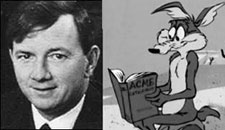
Upon watching Wile E Coyote and his efforts to catch, kill, skin and eat the Road Runner you may have noticed a recurring theme — Wile was always very very close but never quite caught the Road Runner. While we admire his sticktuitiveness (not a word), we scorn his lack of ever trying the same thing twice. We notice the same flaw in Cobra Commander (CEO of Cobra Inc) and also in Megatron (Chairman of the Board for the Decepticon Group). They all shared the flaw of spending a lot on R&D only to give up upon the first failure of their generally well thought out plans and technology. We always wonder what would have happened if only Wile E Coyote had tried one of these traps/plans more than once — surely the Road Runner couldn’t make the same improbable miraculous elusion TWICE. It’s just not statistically likely that a once in a millennium type of event would happen again. So you should always try a failed genius plan at least one more time per the Wile E Coyote Theory of Management. Well, now we know (and knowing is half the battle).

Now, Mr. Meriwether’s biggest fund, a bond portfolio, has plunged 28% this year….

Mr. Meriwether’s recent troubles partly stem from borrowing. His bond fund had $14.90 in borrowed money for every $1 in equity at the end of February, according to the March 18 letter.

Mr. Meriwether marketed his bond fund as a lower-risk version of LTCM’s core strategy, of identifying the next financial crisis and profiting from it by buying securities its managers consider underpriced. Investors were told that the firm would aim to keep borrowings below 15-to-1 even during less-volatile times.

JWM’s Relative Value bond fund, launched in December 1999, has lost 28% this year through last week after notching a 5.6% return in 2007, according to people familiar with the fund. The recent losses further weigh on the fund’s average annualized return since inception of about 7% through February 2008. The Lehman Brothers U.S. Aggregate Index, a measure of investment-grade bond performance, has returned an annualized 6.5% during that period.

Recommendation: Leverage kills. Short funds that are dependent largely on leverage to generate even sub-adequate returns, especially ones that were amazingly collecting 2 and 20 for it and ones run by people associated with the worst hedge fund blow-up ever, having had their hubris chronicled in a popular book. We recommend that Meriwether be permanently elevated to the role of Chief Investment Coyote and only be allowed to manage the Acme Family of Funds.


« Previous PageNext Page »