Archive for 2008

What’s Good for GM…

“General Motors Corp., the biggest U.S. automaker, said it still has enough liquidity through 2008.” And then what?
If you say you have enough liquidity through the end of the year, you don’t have enough liquidity.

Recommendation: What’s good for GM (subprime loans, CLOs, etc.), is not good for the country.


Quotes Entirely Relevant to Investing 05-11-2008

You know, the usual: supreme power, undue influence over others, world domination.
-David Harding of Winton Capital Management when asked about what drives him in Traderdaily

Past Quotes Entirely Relevant to Investing


How Inefficient Are Seals?

Where the walrus puts the sealThis report on seals has us further concerned about the prospects of the entire species.

After 45 minutes the seal gave up, swam into the water and then completely ignored the bird it had just assaulted, the scientists report.

Walruses are models of efficiency. Can you see a walrus ignoring a bird it assaulted? Or do you think he’d make sure the assault was properly finished and the bird either consumed or appropriately stored for later consumption at his Balrus pad?

But the scientists who photographed the event speculate that it was the behaviour of a frustrated, sexually inexperienced young male seal.

Again, a walrus is a model of efficiency. Can you see a walrus doing this, or more apt, a walrus not getting his balrussing on regardless of his experience level? When your species specializes in getting it done, there is never any frustration. There are also no excuses. This is the code they live by.

Recommendation: There is a reason that the movie Andre sucked, and it wasn’t due to the all-star human cast, or the incredible cinematography or the director who shares the same name of the director of Mad Max, but is not actually the director of Mad Max. Hell, you can’t even blame Maine (in this case). No, the problem with that movie was that it wasn’t called Rufus, and wasn’t centered around a walrus with the same name. That movie would have won critical acclaim and probably been so good that just having seen it would get you laid. Additionally, we can’t see seals being a credible species in the context of Global Squidding. Short the seal.

HT to girl


Translating Corporate Speak: Wynn [Unforeseen Upside Edition #2]

In February, we pointed out Steve Wynn’s colorful and frank commentary on his company’s quarterly call. Today, we follow up with more from the CEO of Wynn (Nadaq: WYNN).

First, if you recall, Wynn issued $660mm of shares at $154 at the end of September after his stock had doubled in 6 months. Explaining his reasoning, he said at the time:
“No company gets to be worth twice as much in 60 days as it was before to any intelligent person, so when that happens, we take advantage of it.”

Smart. Now, one quarter later Wynn has repurchased 2.4 million shares. As he said on this quarter’s call:

“Look, we issued 4.4 million shares for 660 million and promptly distributed it, which was really nice for us shareholders. And a return of capital. We have now bought back at 50 or $60 a share [cheaper] those shares that we issued.”

Translation: You were idiots to buy my shares at $154. But I appreciate you selling them back to me at $95. Thank you.

Additionally, while most companies talk up their own business and exaggerate the prospects and profitability of the business, Wynn opts for honesty.

We report and talk about these EBITDA numbers with our chest puffed out as far as we can get it as an industry. I suppose it tells you how much money you can afford to pay in interest. But the public needs to understand that the profitability, the real profitability of these businesses are much, much less than these puffy EBITDA numbers. Interest expense is very large. And depreciation, I know office building guys and shopping center guys and apartment guys, they get to spend part of the depreciation. But, believe me, in my 40-year history and in the history of every other gaming company here, Kerkorian would agree with me. We spend depreciation. It is a real expense. And when you take the profitability of a hotel like the Venetian or Wynn or Bellagio or any of us it’s a much smaller number when you subtract depreciation and interest. And amortization. We have to pay back the people who lend us the money eventually. It’s a much smaller number. But I know the Wall Street folks, you all like to talk about EBITDA.

Translation: I don’t understand why you think my capital intensive company should be valued on metrics that exclude any measurement of capital intensity. I would use a different approach than you muppets, but then again, your approach is lining my pocket and I will restrict letting you know this explicitly such that no one will pick up on it except those who can parse my words with some kind of proprietary translation algorithm for corporate speak.


Quotes Entirely Relevant to Investing 05-04-2008

I think that a man should not live beyond the age when he begins to deteriorate, when the flame that lighted the brightest moment of his life has weakened.
-Fidel Castro

Past Quotes Entirely Relevant to Investing


Improve the Real Estate Market, Make Mortgages Out of Corn

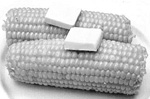
Adjustable Rate Corngages with Butter teasersWhen America had the desire to prop up corn prices a need for cheap sugar what did it do? Make sugar out of corn.

When America had the desire to prop up corn prices a need for an alternative source for cheap liquid gasoline? Make gasoline (ethanol) out of corn (and out of pigs via piganol).

Now America has a floundering real estate market and the need for cheap domestic financing to prop it up. What should she do? Make mortgages out of corn. Turn what is plentiful into what is scarce. Simple.

Corngages can be produced by converting corn into cheap financing by a special process invented by Orville Redenbanker. The best part is that it is a green friendly and renewable source of mortgages, an important point in a world where sustainability is stepping to the forefront. While there are some side effects (including but not limited to: a large amount of emissions which melt the ozone and an increased price of corn, which means an increased price of everything for which corn is an input or a substitute), they can be “offset” by employing other corn products such as cornbon-offset and corn price deflators.

Recommendation: We recommend being long corn, long real estate and long any problem which can be solved by corn, which as far as we can determine is EVERY problem.


The Off-Off-Balance Sheet

A lot of banks have a lot of bad paper in many different forms. Some of it is from ill-advised and underwritten LBOs which top-ticked the buyout market. Some of it is from complicated structured products based on real estate, bank loans, student loans, what have you. Some of it is even financing used to fund a chain of off-balance sheet restaurants to serve the growing off-balance sheet community (as many of you know, this is a space currently under served with respect to basic amenities, more on this in the future).

Regardless, due to the current credit crunch crisis banks are very desirous of (read: being forced to find) a way to unload a lot of debt from their balance sheet. But where to put it? Off-balance sheet locations are coming under increasing scrutiny whether they come in the form of SIVs, super-SIVs, of ultra-megawide–thisonewillwork-SIVs. Under the carpet is where they keep the trillions of derivative exposure, so there’s no room there. If only there was a way to OUTSOURCE the off-balance sheet.

And now there is. The latest credit product is the new OFF-off-balance sheet provided by Private Equity Shop Y and Hedge Fund X (as seen on the internet). In exchange for below market financing, loose structural terms, and a 10-20% down payment, the off-off-balance sheet structure is designed to take an undiversified smorgasborg of the bank’s very own hung deals fresh from the bank’s books. The banks liked it so much, they underwrote it at par, so it must be a steal at 89!

Recommendation: Being that off-off is a double negative, we think that maybe, just maybe, that selling loan assets to highly leveraged entities to which you provide the financing is more of a shell game than a credible solution.

Haha, gotcha! That’s crazy talk, this time it’s different. Between the new Citibank (NYSE: C) reality distortion field and the new non-SAAP acounting measure Earning Before Everything, the bottom has been put in.


EBITDAGSAC: A Guide to Cash Generation for Bankers

Submitted by reader cjm in response to Earnings Before Everything

Many have noted that EBIT is a bad measure of a company’s ability to pay down debt because it includes abstractions like Depreciation and Amortization that aren’t really cash expenses. Hence, EBITDA.

But why stop there?

Your Sales and Marketing team are bounty hunters by blood; let them sharpen their hunger a little.

Thus, I propose EBITDAMS.

Of course, I am about to outdo myself. Aren’t General and Administrative expenses highly theoretical at the end of the day? Is Cindy in accounting, with her two plump mortgages, really going to stop coming to work if you don’t pay her for a quarter?

Thus, (say it with me) EBITDAGSA.

What about COGS, you ask? The power of my theory is rivaled only by its subtlety: pay your vendors in stock options. (for the novitiate: options are a kind of theoretical scrip, not dissimilar from Camel Bucks, Mexican pesos, or Monopoly money.)

Thus, EBITDAGSAC.

By this transformative metric, no business can reasonably be said to be too expensive. It’s like beer-goggles for acquisitions; that 40 P/E heifer with acne scars is a waifish 1/1 cindarella after a few pitchers of EBITDAGSAC.


Quotes Entirely Relevant to Investing 04-27-2008

Wooo!!! Business drunk! More business juice please!
-Liz Lemon on 30 Rock

Past Quotes Entirely Relevant to Investing


New Non-SAAP Measure: EBE

Many companies provide an EBITDA figure along with their earnings, and they let you know it’s a non-GAAP measure, because, well, it’s a non-GAAP measure. Like Skittles, EBITDA comes in a rainbow of fruity flavors: adjusted EBITDA, EBITDAR, EBITDAM, EBITA, EBITDARP, EBITDARM, EBITDARPO, EBITDO and when times get really bad REBITDA.

We think there is an ample opportunity for the introduction of a new non-SAAP measure, one we call EBE or Earnings Before Everything. Let’s cut to the chase, let’s not dicker around, people use EBITDA as a proxy for free cash flow but management wants to use it as a way to inflate the appearance of a company’s health and what better way to do that than EBE? Add-back whatever you want, add it all back, even stuff the firm has nothing to do with. How much did the Chunnel cost? $100 billion? Add that back. Katrina cost a lot too. Add that back. That earthquake in Pakistan or Mexico or wherever? Add that back. Did you donate to charity? Add it back. Did you write something down? Add it back. Did you write something up? Use your discretion to not back that out.

Recommendation: Whenever I see EBITDAM, I say it in my mind like someone who is really surprised at EBIT. Like “EBIT, DAMN, those results are amazing!” or “EBIT-DAM! Cash flow is king!”


Your Favorite Kind of Candy, Please Respond, Now

We are conducting some research, which we plan to analyze rigorously, produce a model from which to profit, front-run the publication of such a model and then, lastly, publish said model.

Please, answer these questions in the comments section

Favorite Candy when you were
6 years old:
16 years old:
26 years old:
And (if you are older than 30) today:

Thank you for your time.


More Frankonomics

Barney Frank is in full regulator, politician-in-need-of-something-to-yell-about mode. Unfortunately, I must note that Mr. Frank is among our most financially-savvy elected officials (gulp) as well as one of the leading advocates of Zimbabwenomics. In this interview with the Economist, he discusses his misguided rationale for dealing with the current financial mess and, as any good politician should, proposes to 1) increase government regulation and 2) increase taxes.

1)

“[Hedge funds and unregulated pools of capital] caused the problem by making a wide ranges of loans that shouldn’t have been made. Now some of the borrowers shouldn’t have borrowed… but there was no regulation to prevent abuse.”

“If only [banks and credit unions] were the originators, there would be no subprime crisis and no recession today.”

Now every major US bank I can think of – Citigroup, BofA, Wells Fargo, etc. — has written down billions in losses from the sub-prime, Alt A, sub-crap, and moderate-crap mortgages they held. Additionally, they are still trying to unload the billions of remaining debt still on their books from their loans to the only group more levered than sub-prime borrowers: private equity firms. These banks were regulated but they still participated, enabled, benefited from, and ultimately suffered as a result of the sub-prime fiasco. Why? Because the problems that the financial system has suffered over the last 18 months are the result of an expansionary credit cycle. Credit begat credit until temporarily insane lenders gave cash to un-worthy borrowers. Sub-prime were the symptom of this craze rather than the cause and while regulation may have been able to stem some of the more egregious abuses, an expansionary credit cycle will find a way to wreck damage.

Here’s Warren Buffet on the subject:

There are significant limits to what regulation can accomplish. As a dramatic illustration, take two of the biggest accounting disasters in the past ten years: Freddie Mac and Fannie Mae. We’re talking billions and billions of dollars of misstatements at both places.

Now, these are two incredibly important institutions. I mean, they accounted for over 40% of the mortgage flow a few years back. Right now I think they’re up to 70%. They’re quasi-governmental in nature. So the government has set up an organization called OFHEO. I’m not sure what all the letters stand for. But if you go to OFHEO’s website, you’ll find that its purpose was to just watch over these two companies. OFHEO had 200 employees. Their job was simply to look at two companies and say, “Are these guys behaving like they’re supposed to?” And of course what happened were two of the greatest accounting misstatements in history while these 200 people had their jobs. It’s incredible. I mean, two for two!

It’s very, very, very hard to regulate people.

LoS prediction: Frank and his legislative cohort will find a way to prevent any of the abuses of this cycle from recurring. Say good-bye to pick-n-pay, Freedom, and pay option loans. However, this regulation will do nothing to prevent the excesses of the next expansionary credit cycle, scheduled to start in 2012 which may include Magic Loans, Money Tree Triple-Reverse Amortizing ARMs (if it works in old-time college football, it can work in loans), Collateralized Magic Loan Obligations, Ultra-SIVs and our favorite, Chocolate Covered Mortgages, which will not not only be affordable but delicious.

2)

“First, try to pay as little as possible [to bail people out].”
“I’m willing to give [homeowners who can’t afford their houses] some help. Not direct taxpayer assistance but some other type…”

“They didn’t bail out Bear Stearns. [The Fed] bailed out the people who did deals with Bear Stearns.”

Now for the classic politician’s sleight of hand. When people won’t tolerate direct transfers of wealth, make the transfers indirect. The First Law of Bailouts is that Someone Must Pay. So when Barney says that he’s willing to give homeowners who speculated on housing (and lost) “some help” but that won’t involve direct taxpayer assistance, he’s not quite lying. Instead of giving these people straight cash, he will find some other ways to transfer taxpayer dollars to these people (voters).
Similarly, it’s true that the Fed didn’t bail out Bear Stearns. After all the company was sold to JP Morgan and the employees lost most of their equity. However, he failed to mention that the Fed DID bail out the Bear Stearn’s bondholders [see John Hussman’s insightful analysis] who did nothing to deserve the preferential treatment.

Recommendation: Stop voting for politicians who cannot think more than 2 steps ahead of themselves. Stop voting for politicians who have never heard of the 2nd (forget about the 3rd) order effects.


Thank You Child

Dear Future Child of Mine [Chase or Madison depending on your gender],

Thank you for the tax rebate. $600 was a very generous gift for such a small child. I know that, at some point in the future, you will have probably have to work a full week — taxes will be higher — to pay for this gift. So I want you to know that I really appreciate it. I have been frivolous lately and made some bad decisions (the 2nd home with the pik-n-pay mortgage, the jacuzzi, the viking kitchen) that I really couldn’t afford. So I’ll probably use the $600 to pay off some of my personal debt. That will leave less debt to eat into the estate I’m planning to leave you (post-tax, of course)!!

Sincerely,
Dad


Citi’s New Financial Product: Reality Distortion Field

Citigroup (NYSE: C) announced first quarter fiscal earnings. The results were incredibly good and the stock has subsequently surged almost 10%. WSJ article on Citi’s Q1 release:

The loss of $5.11 billion, or $1.02 a share, was deeper than Wall Street had expected and took the bank’s total loss over the past two quarters to nearly $15 billion.

Citigroup’s first-quarter revenue plunged 48% to $13.22 billion amid the write-downs. Analysts polled by Thomson Financial had expected a loss of 95 cents a share on revenue of $12.77 billion. A year ago, Citigroup reported net income of $5.01 billion.

They also announced, via brain-wave subversion transmitters, that they have developed a Reality Distortion Field, a device long-rumored to have been in the possession of Steve Jobs but which has only actually been developed and effectively utilized by Citi.

Recommendation: If you can get the financing to buy a large truck, which may be difficult since no banks are lending money to anyone at the moment (but don’t worry, their future results will still be killer because the business of banks is not actually the loaning of money to people and stocks don’t consist solely of a company’s future earnings), we recommend backing that truck right up to the biggest pile of Citi stock you can find. The Write-Down Rally has been one-upped by the Write-Down AND Miss Expectations Rally.


« Previous PageNext Page »